
When planning interiors, most homeowners focus on design elements like colors, finishes, and furniture styles. However, one of the most critical factors in interior design is often overlooked — the quality of plywood.
Plywood plays a key role in determining the durability, strength, and long-term performance of furniture and interiors. Studies in construction materials indicate that a significant portion of furniture failures are linked to poor core material quality rather than external finishes.
Choosing the right plywood ensures that interiors remain stable, functional, and long-lasting.
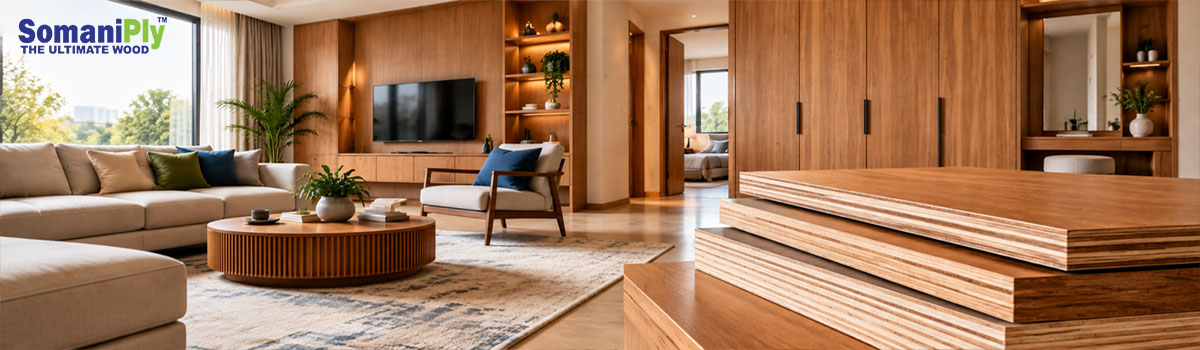
What is the Role of Plywood in Interior Design?
Plywood forms the structural base of most interior elements, including:
- Modular kitchen cabinets
- Wardrobes and storage units
- TV units and wall panels
- Office furniture and partitions
It distributes load evenly and resists stress. Compared to solid wood, plywood offers better dimensional stability due to its cross-layered construction, reducing the chances of warping or cracking.
Why Plywood is the Most Important Interior Material
Strength and Load-Bearing Capacity
High-quality plywood supports weight efficiently, ensuring that shelves, cabinets, and furniture maintain their shape over time.
Moisture Resistance
In areas like kitchens and utility spaces, moisture-resistant plywood such as BWR and BWP helps prevent swelling, warping, and structural damage.
Long-Term Durability
Good-quality plywood maintains its structure and finish for years, reducing the need for repairs and replacements.
Dimensional Stability
The cross-grain structure of plywood minimizes expansion and contraction, making it more stable than many alternative materials.
Types of Plywood Used in Interior Design
MR Grade Plywood (Moisture Resistant)
- Suitable for indoor furniture and wardrobes
- Ideal for low-moisture areas
BWR Plywood (Boiling Water Resistant)
- Best for kitchens and semi-wet areas
- Offers better moisture resistance and bonding strength
BWP Plywood (Boiling Water Proof)
- Suitable for high-moisture environments
- Ideal for kitchens, bathrooms, and utility spaces
Learn more about SomaniPly BWR / BWP grade plywood for moisture-prone interiors.
Plywood Comparison Table: MR vs BWR vs BWP
| Feature | MR Plywood | BWR Plywood | BWP Plywood |
|---|---|---|---|
| Water Resistance | Low–Moderate | High | Very High |
| Best Use | Bedrooms, wardrobes | Kitchens, utility areas | Wet areas, kitchens, bathrooms |
| Durability | Moderate | High | Very High |
| Moisture Exposure | Occasional | Frequent | Continuous |
| Lifespan | 5–8 years | 8–12 years | 10–15+ years |
| Cost | Lower | Medium | Higher |
Choosing between MR, BWR, and BWP plywood depends on where it will be used. For moisture-prone areas like kitchens, BWR or BWP plywood is recommended, while MR plywood is suitable for general interior furniture.
Common Problems Caused by Low-Quality Plywood
Using poor-quality plywood can lead to:
- Swelling due to moisture absorption
- Delamination or layer separation
- Bending or sagging shelves
- Reduced load-bearing capacity
- Increased maintenance and repair costs
Over time, these issues reduce the lifespan of interiors and increase overall expenses.
How to Choose the Best Plywood for Interiors
To ensure durability and performance:
- Select the correct grade (MR, BWR, or BWP) based on usage
- Check for uniform thickness and strong bonding
- Ensure moisture and termite resistance
- Choose reliable manufacturers with consistent quality
- Avoid selecting plywood based only on price
For a deeper buying guide, see how to choose the right plywood for Indian climate conditions.
Why Plywood Quality Matters in Indian Conditions
In cities like Bangalore and across Karnataka, interiors are exposed to humidity variations, seasonal weather changes, and daily usage.
Plywood used in such environments must be able to:
- Resist moisture and humidity
- Maintain structural strength over time
- Perform consistently across different applications
Choosing the right plywood ensures better durability under these conditions. You can also review SomaniPly product specifications when matching grade to application.
Best Plywood for Different Interior Applications
- Kitchen Cabinets: BWR or BWP plywood
- Wardrobes: MR or BWR plywood
- Office Furniture: High-strength plywood
- Wall Panels: Lightweight and stable plywood
Using the right type of plywood for each application improves performance and reduces long-term issues.
Conclusion
Interior design is not just about appearance — it is about performance and longevity. Plywood is one of the most important materials that determines how well interiors function over time.
Choosing high-quality plywood ensures durability, reduces maintenance, and improves the overall lifespan of furniture and interiors.
About SomaniPly
SomaniPly offers high-quality plywood solutions designed for strength, durability, and consistent performance across residential and commercial applications.
FAQs
Why is plywood important in interior design?
Plywood provides structural strength and stability, ensuring long-term performance of interiors.
Which plywood is best for kitchen cabinets?
BWR or BWP plywood is recommended due to its moisture resistance.
What is the difference between MR and BWR plywood?
MR plywood is suitable for indoor use, while BWR plywood offers better resistance to moisture.
How long does good quality plywood last?
High-quality plywood can last 10–15 years depending on usage and environmental conditions.










2 Responses